EXPLORING LOCAL AI IN PRIMARY CARE: KEEPING PATIENT DATA PRIVATE AND SUPPORTING BETTER CARE

We’re exploring an emerging question at the intersection of clinical care, software, and artificial intelligence (AI):

How should AI be used in a clinic to support care in a way that best protects patient privacy?

This work is still very early, and that’s intentional. We don’t have final answers yet, but we do have clear priorities: protecting patient privacy, maintaining safety, and ensuring that any use of AI remains fully under clinical and organizational control. 

In healthcare, that means being deliberate about how patient data is used, while staying open to innovation and new tools that could meaningfully impact care. 

This is an area where progress is important, and where moving too slowly or too cautiously could also limit potential benefits. At the same time, any advancement needs to be approached carefully, with appropriate safeguards in place.

There are still many open questions, and that’s exactly why we’re taking an iterative approach — starting small, learning as we go, focusing on how AI can contribute to clinical work in a responsible, controlled, and well-governed way.


WHY EXPLORE AI AT ALL?

Large amounts of patient information are already managed across primary care teams and clinical systems every day — reviewing charts, identifying relevant history, tracking preventative care needs, and helping patients navigate complex healthcare information.

Some of this work is clinical and decision-based, while some of it is administrative, repetitive, or difficult to manage with traditional tools alone.

The goal of exploring AI in this context is not to replace clinical judgment or automate care decisions. Instead, the aim is to understand how AI may support specific categories of healthcare work where existing processes can be time-intensive, hard to scale, and challenging to execute consistently across systems and workflows.

In practical terms, this may include:

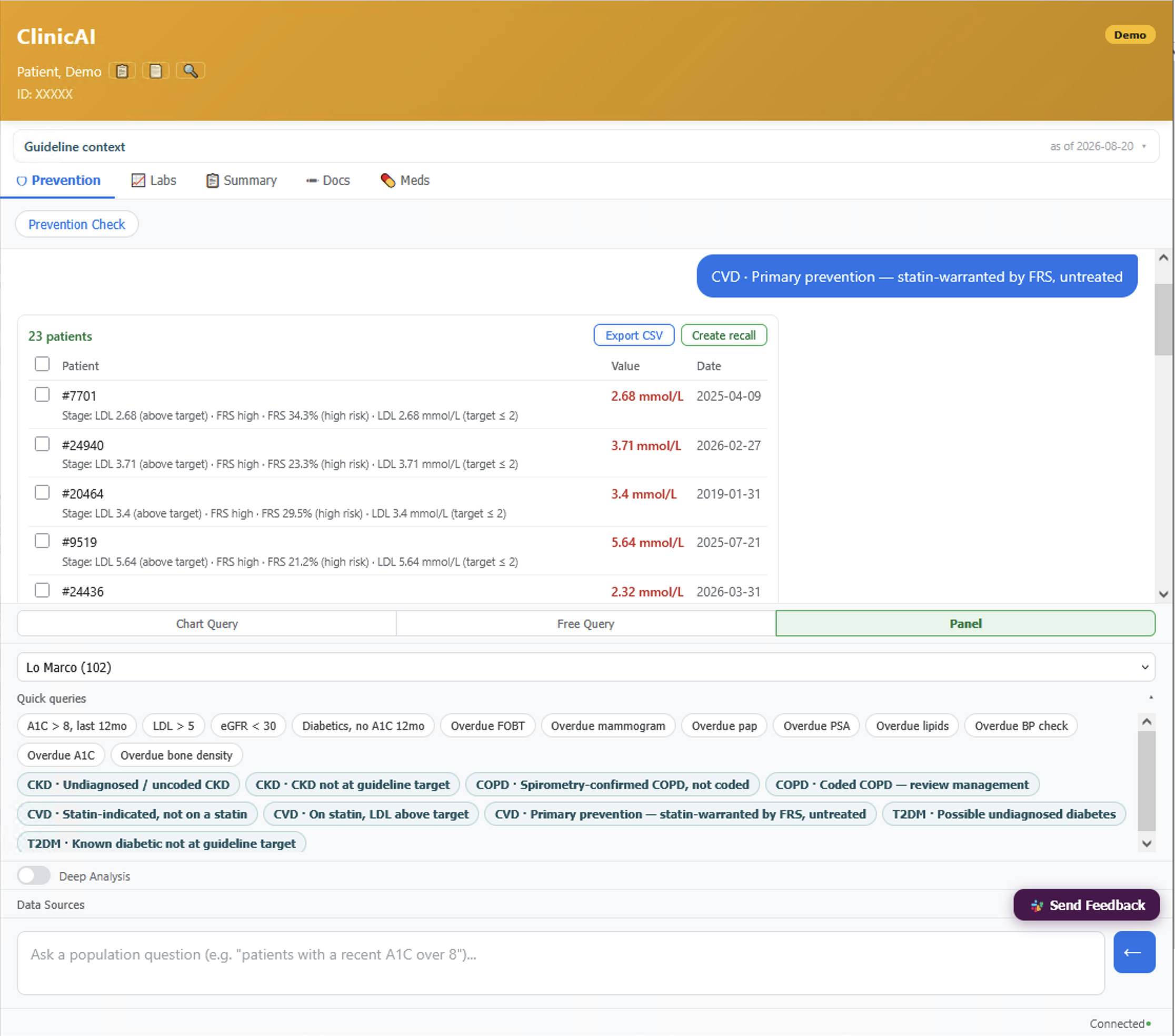
  • Information retrieval and chart navigation tasks: Using an AI-assisted tool inside the EMR that helps clinicians more quickly surface relevant information from large patient charts for review, rather than manually searching through records.

  • Population-level care and preventive workflows: For example, identifying groups of patients who may benefit from specific care pathways (e.g., congestive heart failure or COPD programs) or surfacing preventative care gaps across a patient panel.

  • Low-risk administrative and documentation support: Such as organizing and classifying documents, or helping streamline required tasks by generating first drafts of documentation and summaries.

  • Complex, large-scale record and triage workflows: AI may also assist with preventive care triaging and large-scale record review, helping care teams complete workflows that are technically possible today but difficult to perform efficiently and consistently across large patient populations.

Throughout all of this, clinicians and care teams remain fully responsible for reviewing information, exercising judgment, and making decisions about patient care. 

As with work produced by a medical learner or other clinical support role, AI-generated outputs would be thoroughly reviewed and validated by clinicians in the same way.


WHY “LOCAL AI”?

AI in healthcare naturally raises important questions around privacy, and it should. Patient data is highly sensitive, and how it’s handled matters.

Privacy is the starting point for this work, with a key focus on where and how data is processed.

In many current healthcare AI tools, such as AI scribes, patient information is sent to external, cloud-based systems for processing. Our first use of AI was in this space, and more about our AI and software work can be read here

These tools can meaningfully reduce administrative burden and support clinical workflows, and we continue to use them where appropriate. 

For this exploration, however, we are intentionally focused on a different approach — local AI systems that run within clinic-controlled infrastructure.

That means:

  • Patient data stays inside the clinic environment

  • Information is not sent to public AI platforms

  • Data is not used to train third-party models

  • Access is limited, governed, and auditable

  • Any use is tied to specific, appropriate clinical purposes

When AI is used in healthcare, it should be designed from the ground up to respect the sensitivity of patient information.


WHAT THIS LOOKS LIKE IN PRACTICE

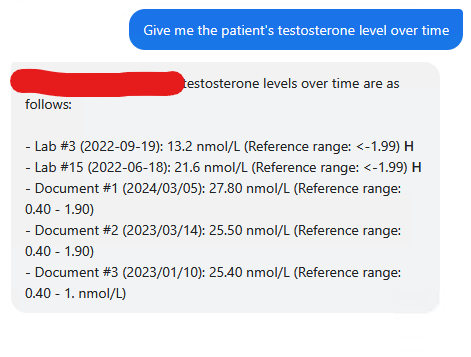
Example of AI-assisted chart review: The AI retrieves and organizes the patient's testosterone results over time, including relevant lab values and dates, for the clinician to review.

This work is still in its early stages.

We’re exploring how AI capabilities could be built directly into our open-source electronic medical record (EMR), where clinicians could interact with tools in a controlled, internal environment.

The funding behind this work — a combination of primary care funding and seed funding — is being directed toward exploring how local AI might be safely integrated into clinical workflows. 

The goal is to use focused, intentional investment to explore ideas that could have an exponential long-term impact.

Some early directions being explored include:

  • Helping clinicians review large charts more efficiently — for example, surfacing relevant history when a new patient is seen after hours, so clinicians can quickly orient themselves to key clinical information. In practice, a clinician seeing an unfamiliar patient after hours for an asthma-related concern could ask the AI to summarize the patient's history of prescribed asthma medications and the documented response to each one, rather than manually reviewing several years of records.

  • Supporting privacy and quality processes — such as assisting staff in reviewing transferred records, where identifying missing or misfiled information can require careful review. Closing the loop on missing medical information is an important part of care delivery at Magenta Health, and you can read more about that work here.

  • Improving preventative care workflows — helping identify patients who may benefit from follow-up care based on existing criteria, such as screening eligibility or care gaps. For example, highlighting when a patient is due for a mammogram, or when family history suggests earlier screening may be appropriate.

  • Improving how information is communicated — for example, translating complex clinician-centred documentation into clearer, more accessible language for patients.

  • Supporting structured summaries of existing patient information — generating clear overviews of medical history to assist preventive care conversations or annual health reviews, where large amounts of patient information need to be reviewed in a structured format.

Importantly, none of this is about introducing new data collection. Instead, it focuses on helping clinicians and care teams better access, interpret, and act on information that already exists in the record.


EARLY-STAGE EXPLORATION THROUGH <BETTER/CARE>

At this stage, local AI isn’t a finished product or deployed system. It’s an early exploration, intentionally small in scope, focused on learning, and guided by a central question:

If AI is used in healthcare workflows, how can it strengthen privacy, support clinicians, and improve care delivery?

This work sits within our broader <Better Care/> campaign — an ongoing effort to improve the open-source EMR system that powers nearly every part of primary care in our clinics, and in healthcare settings across Canada.

If you’d like to learn more about the work behind <Better Care/> or how you can contribute to these improvements, you can find more information here.

There are many possible applications of AI in healthcare. Some may prove valuable, some may not, and some may not be appropriate at all. That uncertainty is exactly why careful exploration matters.

For us, the most exciting part is the possibility that AI can help healthcare teams do the work they already do more consistently, efficiently, and at a greater scale. If that proves possible, it could mean better support for clinicians, more reliable systems, and ultimately better care for more patients.

But first, it has to earn that role. For now, we’re focused on moving carefully, learning as we go, and doing it right.

Summer Updates, Resources & Improvements at Magenta Health

Throughout the year, we’ve continued working on improvements across patient care, clinic operations, and our electronic medical record (EMR), while also sharing new patient resources and healthcare updates with our community.

This summer, we’re excited to highlight some of our recent work and announcements:


Patient Care & Access Updates


Improving Access to Care in Our Communities

Explore how Magenta Health is participating in Ontario’s Primary Care Action Plan, supporting expanded access to primary care through priority intake pathways for communities in need.

Learn more here


The Early MMR Vaccine for Travelling Infants Between 6–11 Months

Travelling internationally with an infant? This is what families should know about early MMR vaccine recommendations and eligibility.

Click here to learn more.


Missing Medical Information and How We’re Closing the Loop

Learn how our care teams and EMR workflows help track follow-ups, outgoing requisitions, and test results to reduce the risk of important information being missed.

Read more here.


The Annual Uninsured Services Subscription (USS) — What You Need to Know

An overview of our optional uninsured services subscription, including what is covered and how it works.

Click here to read more and learn how to sign up.


Our EMR & Clinical Systems


Behind the Scenes: EMR Updates & Improvements at Magenta Health

From security enhancements to infrastructure upgrades, we’re continuing to strengthen the foundation of the EMR that powers care delivery across our clinics.

Read more about our work here.


How We Build & Improve Our EMR at Magenta Health

A closer look at how our software and care teams collaborate to continuously improve the systems that support nearly every part of daily patient care, as part of our <Better Care/> campaign.

Click here to learn more.


Building Beyond Our Clinics: How Our EMR Work Benefits the Broader Healthcare System

Our EMR development work extends beyond Magenta Health, contributing to broader healthcare improvements and collaboration across clinics in Canada.

Read more about our ongoing efforts here.


How Our EMR Is Improving Access to Primary Care

Learn about the ongoing improvements to our EMR system that support more accessible and coordinated patient care across our clinics.

Click here to read more.


Feedback & System Improvements


We’re Asking for Your Feedback — Here’s Why

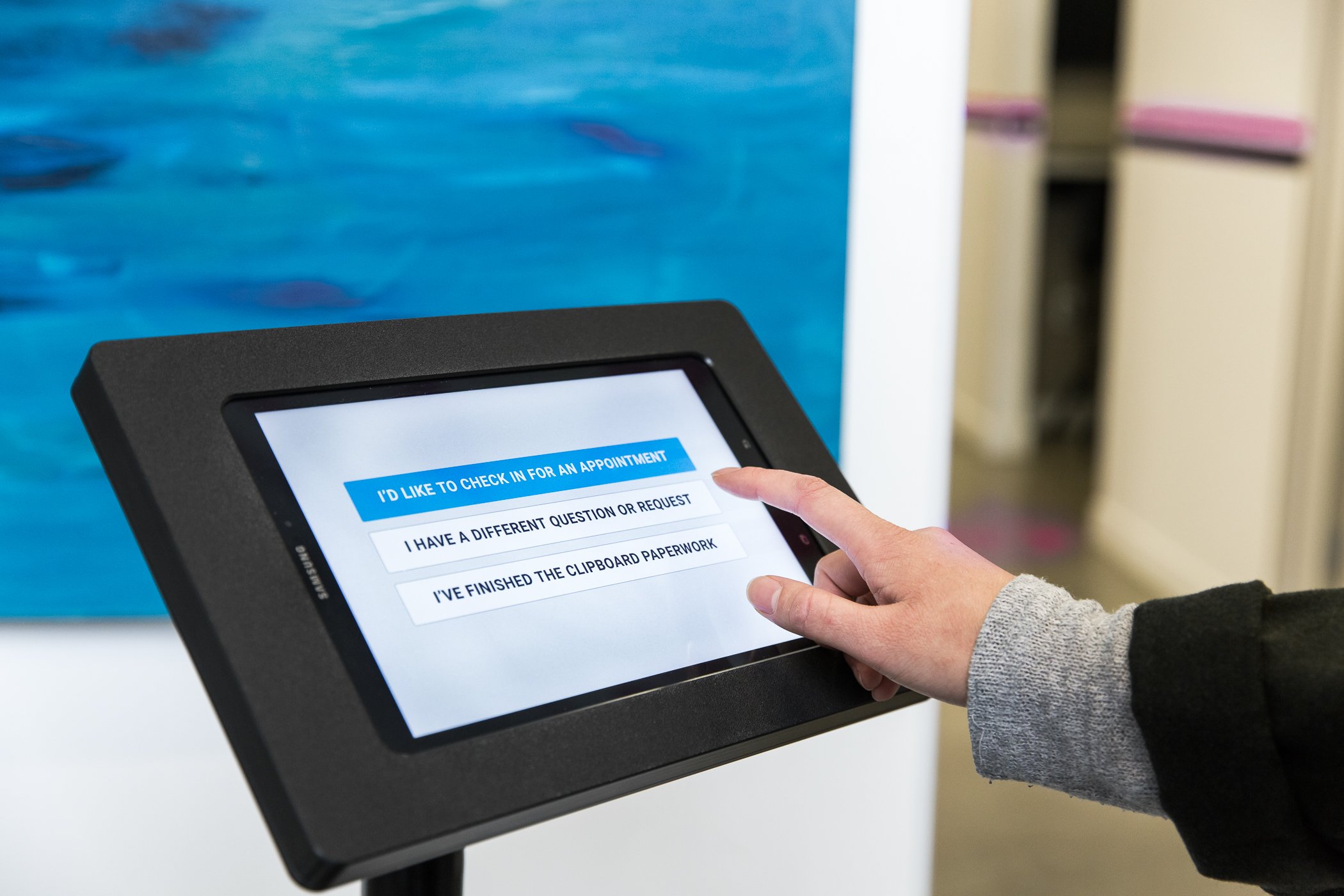
You may now notice a short feedback question at the end of your check-in experience. Here’s why we’re collecting feedback and how it helps us improve care.

Learn more about this change here.


Making It Easier to Access an On-Call Doctor: A Step Forward for <Better Care/>

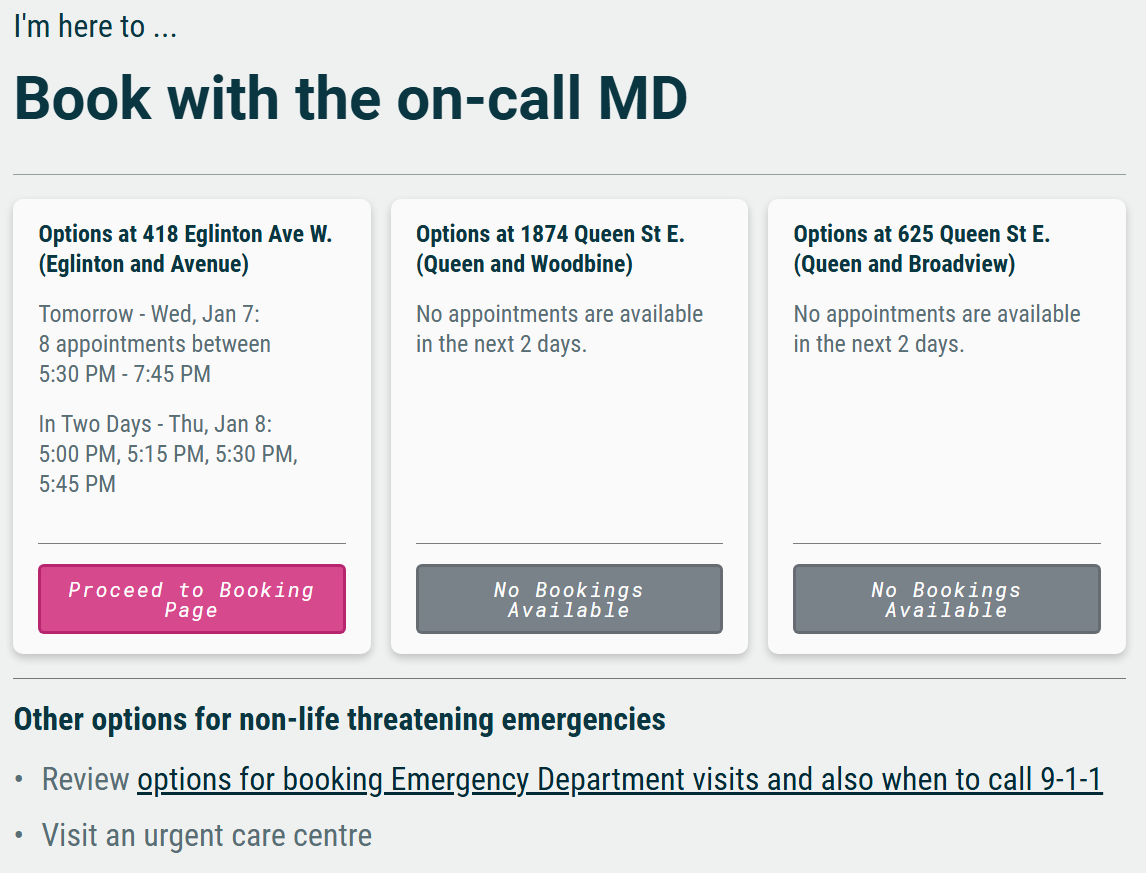
We’ve updated our on-call MD booking workflow to make it easier for patients to access urgent care when they need it. The new process helps streamline booking and makes it simpler to find and select appropriate urgent appointments.

Explore more here.


A Thank You to Our <Better Care/> Community

Read our thank-you letter to everyone who supports our ongoing efforts to improve care and strengthen our EMR systems. 

If you’d like to learn more about or contribute to this work, you can explore our <Better Care/> page here.


Thank you to all of our patients, families, and community members for following along with our work and being part of Magenta Health.

We’re grateful to have you with us, and we look forward to sharing updates, improvements, and resources with you in the months ahead!

INVESTING IN THE PEOPLE WHO BUILD HEALTHCARE TECHNOLOGY: HOW CO-OP STUDENTS CONTRIBUTE AT MAGENTA HEALTH

At Magenta Health, we believe that building better healthcare technology starts with investing in the people who create it.

In a broader tech landscape increasingly focused on reducing headcount and automating work, we’ve taken a different approach — one that prioritizes growing the ecosystem of health IT professionals who will help shape the future of clinical care.

This is especially important in healthcare technology, where the talent pool is small, and the systems are complex, long-lived, and shaped by real-world clinical workflows. 

Our electronic medical record (EMR) is one of these systems. It is continuously evolving, and a key part of that evolution involves bringing in co-op students and early-career professionals to contribute directly to its development.

On our team, co-op students work on a large, long-standing open-source EMR used across clinics in Canada. Through this approach, we’re intentionally investing in people and technology — building systems that support better patient care while developing the next generation of healthcare technology talent.


LEARNING THROUGH REAL SYSTEMS

Credit: Liam Stanziani

One recent co-op student, Liam Stanziani, joined us after working in a different software environment focused on educational simulation tools. 

Initially drawn to the opportunity by our EMR’s open-source nature and its real-world impact, he began a four-month term working on system improvements.

Throughout his co-op, Liam contributed to a range of practical enhancements across the EMR, including improving e-form functionality, strengthening system security features, and supporting ongoing bug fixes and updates.

Many of these improvements are shaped by feedback and suggestions from our clinicians and care teams, which the software team translates into practical changes within the EMR.

The EMR reflects more than two decades of contributions from developers with a wide range of backgrounds, giving students insight into how real systems evolve through many hands, and how past decisions continue to shape the platform they are building on today. 

This creates a unique co-op learning environment, where students see firsthand how complex healthcare systems are continuously refined in practice, and how design choices can directly impact care delivery.

Liam has since transitioned into a full-time role at Magenta Health, where he continues to contribute to ongoing EMR development as part of the team. 

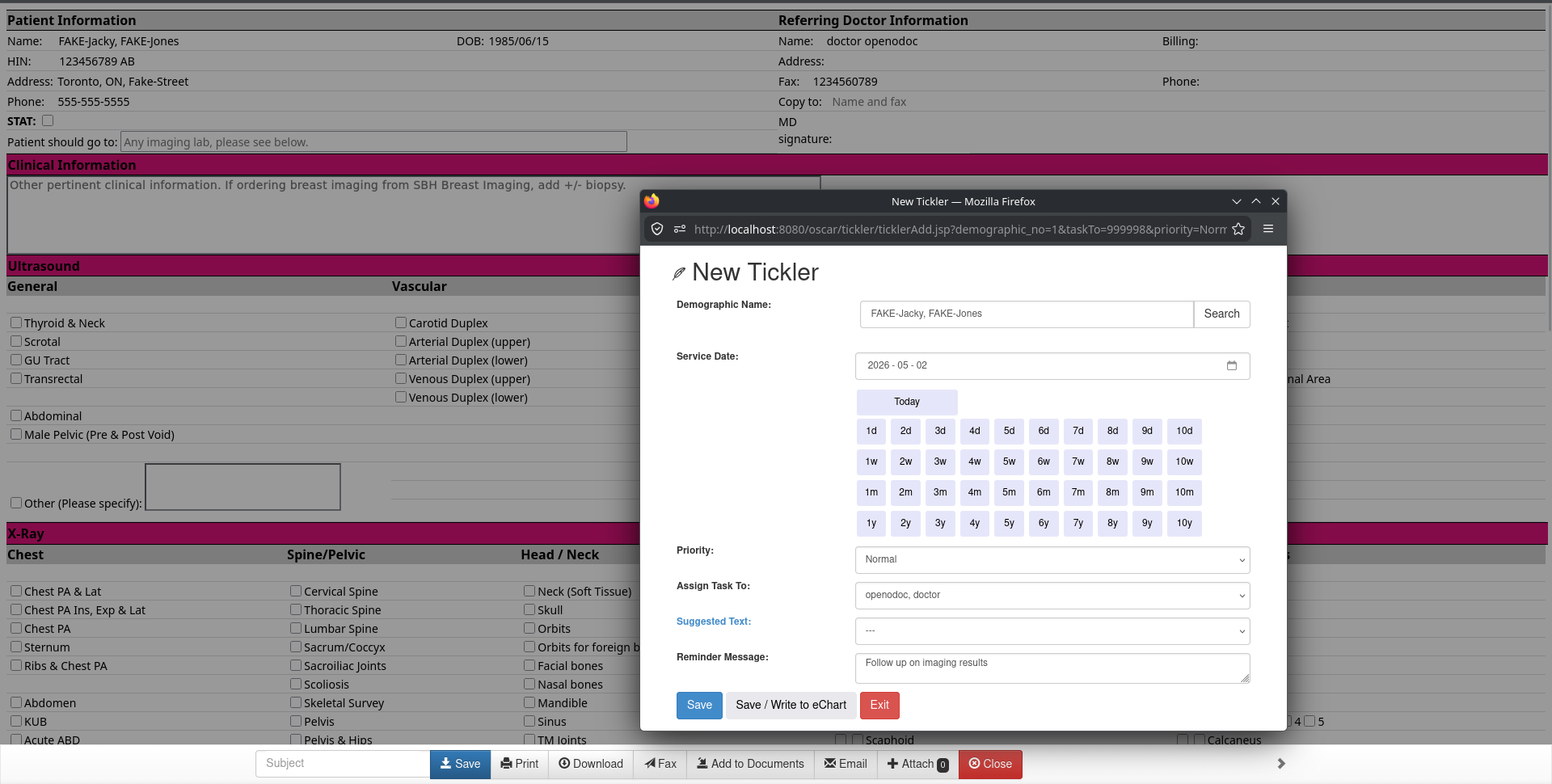
In his current role, he has worked on connecting e-forms to clinical “ticklers” — task reminders used by care teams to manage follow-ups. This integration helps ensure that follow-up actions can be created directly from submitted forms.

Upcoming release to the EMR. Credit: Liam Stanziani

He has also built an upcoming enhancement that builds on this workflow: when a clinician submits an e-form (such as a lab requisition), the system will automatically open the “Add Tickler” window, making it easier to create follow-up reminders at the point of submission. This helps reduce the chance that follow-up steps are missed.

He also continues to work on enabling secure sharing of provider documents within e-forms to support collaboration across clinicians, along with ongoing security improvements across the EMR.

Learn more about how we build and improve our EMR at Magenta Health here.


SUPPORT AND MENTORSHIP

Throughout the co-op experience, students are supported through close collaboration with senior team members. 

This includes structured check-ins, day-to-day touchpoints to discuss progress and challenges, and ongoing mentorship from experienced developers and technical leads.

Students also have opportunities to connect directly with leadership, including our co-founders, gaining broader insight into how technical projects and decisions align with clinical and organizational priorities.

In some cases, this experience extends beyond a single term.

We’ve had students continue working with us in full-time roles, where support evolves alongside their responsibilities and remains grounded in a collaborative, team-based approach.


MUTUAL VALUE: BUILDING AND LEARNING

Credit: Andrew Moca

Co-op programs at Magenta Health are designed as a two-way investment.

Students gain hands-on experience working on real healthcare infrastructure, while the organization benefits from fresh perspectives, technical contributions, and the curiosity that early-career developers bring.

This model also allows us to expand the capacity of our team, helping us continue investing in EMR improvements while supporting meaningful learning opportunities for students.

This is especially important in healthcare technology, where demand for skilled developers continues to outpace supply, and where growing future talent is essential to sustaining and improving complex clinical systems.

We welcome talent from a wide range of backgrounds, recognizing that strong technical contributors — including those who have trained or built experience outside of Canada — play an important role in advancing healthcare systems.

Bringing in new talent helps strengthen the system today and supports the development of the next generation of healthcare technology professionals.


LOOKING AHEAD

As the healthcare landscape continues to transform, the intersection of clinical care and technology will only become more important.

Co-op programs are one way we’re supporting this shift — helping to build talent, strengthen systems, and contribute to the ongoing evolution of an EMR that clinicians and patients across Canada rely on every day.

This work is part of our broader <Better Care/> campaign, focused on continuously improving the open-source electronic medical record that supports nearly every part of care.

Through ongoing EMR development, we’re working to create safer, more reliable, and connected infrastructure for healthcare delivery.

To see some of the recent improvements we’ve made to the EMR, explore our latest updates here. If you’re interested in contributing to this meaningful work, you can support our EMR efforts here.

A Thank You to Our <Better Care/> Community


Over the past two years, more than 200 generous individuals have supported our <Better Care/> campaign, and we’re incredibly grateful. 

To everyone who has contributed — thank you.

Your support has played a direct role in our work to improve the electronic medical record (EMR) system.

The EMR powers nearly every part of care delivery in our clinics and across healthcare settings in Canada.

This work often happens behind the scenes, but its impact is very real.


EMR improvements shape how clinicians access patient information, how efficiently care teams can work, and how reliably patients receive follow-up, preventative care reminders, and clear communication. Even small system improvements can translate into meaningful differences in how care is experienced day to day.

Because of your support, we’ve been able to continue building and improving these systems — not just within Magenta Health, but in ways that extend beyond our own clinics.

If you’d like to see what that work looks like in practice, we’ve shared a few new updates below:

Each of these reflects ongoing work to make care safer, faster, and more reliable for both patients and care teams.


Behind this work is a significant investment from Magenta Health's founders and physicians, who have voluntarily contributed more than $100,000 each year, alongside countless volunteer hours.

Partnerships with students, academic institutions, and publicly funded research initiatives have helped extend the reach of these efforts even further.

Our goal is to grow this investment to more than $400,000 annually so we can continue tackling some of the healthcare challenges that matter most to patients and care teams.

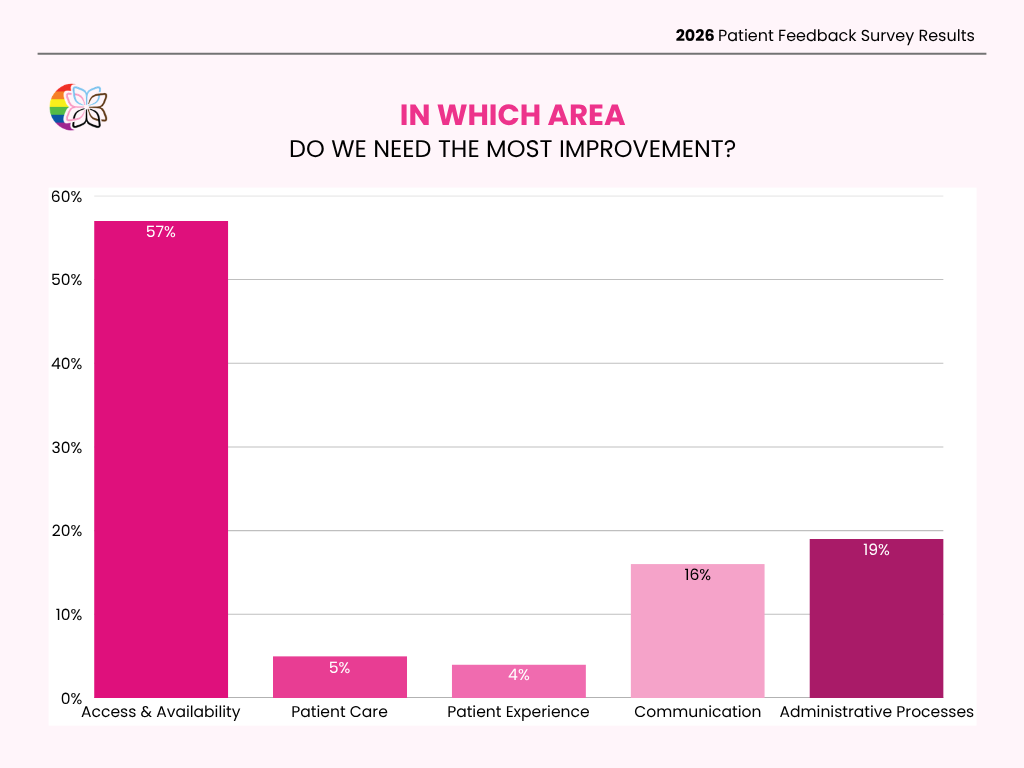
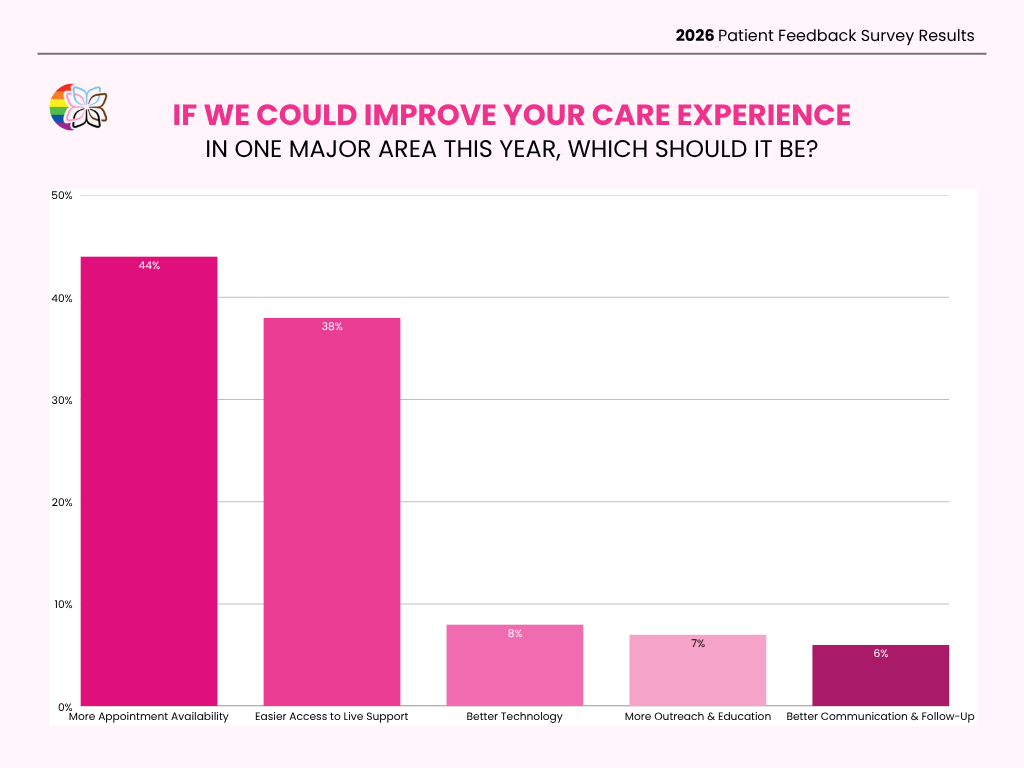
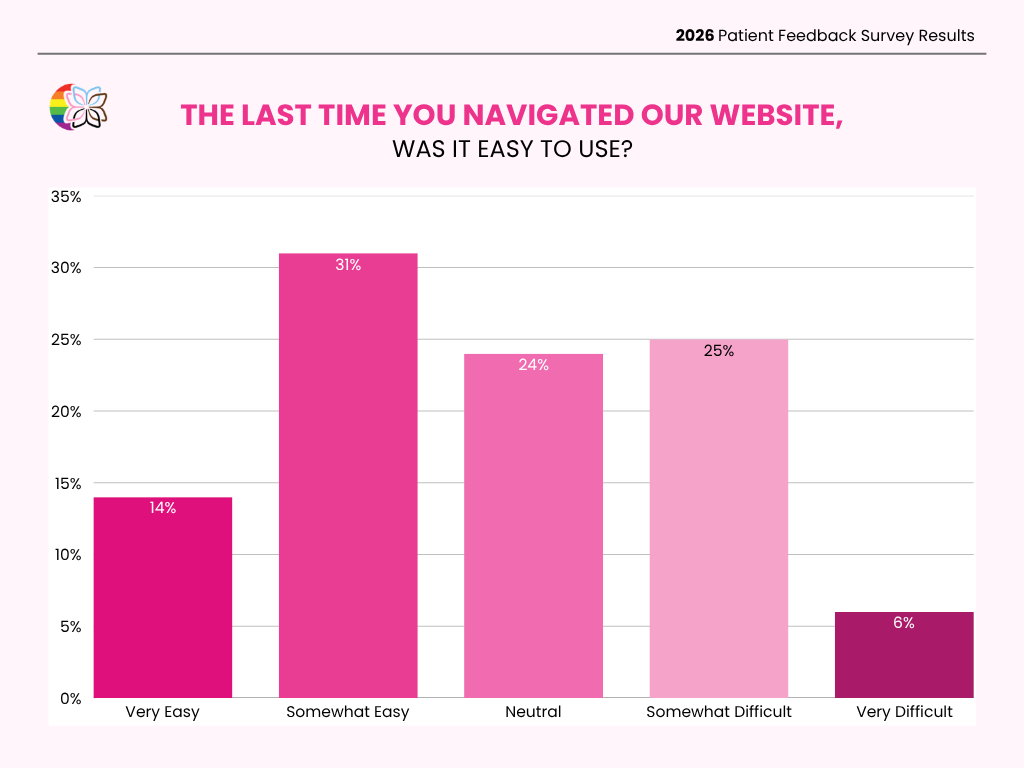
Recently, we've also been gathering input through patient surveys and actively using that feedback to help shape future <Better Care/> initiatives.

One of the clearest themes we've heard is that people aren't always sure what steps they should take to proactively manage their health. 

Helping patients better navigate their care, understand available resources, and stay informed will be a major focus of our efforts in the coming year.


<Better Care/> is built on the idea that improving the systems behind healthcare can significantly improve care itself. 

Your support is part of what makes that possible.

If you’d like to continue supporting this work and help shape the future of care delivery across Canada, you can join our community of <Better Care/> supporters here.

And if contributing financially isn’t possible, that’s completely okay — there are other ways to support this work, and you can explore those here.

Thank you again for being part of this journey.

HOW OUR EMR IS IMPROVING ACCESS TO PRIMARY CARE

In our clinics, we see technology as a key part of making healthcare more accessible and responsive to patient needs.

Our electronic medical record (EMR) plays an essential role in how care is delivered. It’s where patient information enters, is reviewed, and securely stored — but it also supports many of the day-to-day functions that keep clinics operating, from appointment scheduling and internal communication to coordinating follow-ups, referrals, and ongoing care. 

Without it, primary care delivery would not function, and improvements to the system directly impact how patients access care.

By investing in these systems behind the scenes, we’re working to reduce barriers, support more flexible care options, and help every patient connect with the care they need in ways that work for them.


REDUCING BARRIERS THROUGH VIRTUAL AND FLEXIBLE CARE

One of the most meaningful ways technology supports access is by making care more flexible.

Primary care doesn’t always require an in-person visit. In many cases, interactions can be handled through alternative pathways, depending on the clinical context.

Our EMR supports tools that help patients access care in a range of ways, including:

  • Secure electronic messaging with their care team

  • Virtual appointments when appropriate

  • Requesting prescriptions without an appointment

  • Requesting insurance documentation or medical forms

  • Accessing vaccination records or support for applications such as school or daycare

These options can make a significant difference for patients facing barriers such as:

  • Mobility or transportation challenges

  • Work or caregiving responsibilities

  • Geographic distance from clinic locations

  • Time constraints that make in-person visits difficult

We’re also continuing to refine how virtual care is used in practice. As a team, we’re learning what works well in a virtual setting and where in-person care is more appropriate.

For example, follow-ups and check-ins often work well virtually, while new or more complex concerns may be better suited to in-person visits. This ongoing learning helps ensure that virtual care supports access without compromising quality.

Messaging and virtual care tools also support continuity of care. Automated messaging helps keep patients informed, ensures important updates are received, and provides timely reminders for preventive care when appropriate. This reduces missed communication and improves follow-through between visits.

Together, these care pathways help make it easier for patients to access care in ways that fit their needs and daily lives, while also supporting clinicians in delivering care more effectively.


IMPROVING ACCESS THROUGH BETTER NAVIGATION

Access also depends on how easily patients can find and navigate the care they need.

We’ve done significant work to build and continuously improve our Digital Front Door (DFD), making it easier for patients to access services through our website.

For example, patients can request services such as cancer screening through the DFD, which is connected to our EMR. The system can check whether a patient is due for a mammogram or cervical cancer screening and guide them accordingly — whether that means booking an appointment or confirming they are already up to date.

This reduces the need for phone calls or in-person visits just to access information, and helps ensure patients are directed to appropriate care with up-to-date guidance on what they need and when.


TECHNOLOGY THAT SUPPORTS BETTER ACCESS

The EMR is central to nearly every part of a patient’s care journey, from booking appointments and documenting visits to reviewing results and managing follow-ups.

While no system can solve all access challenges in healthcare, thoughtful design can reduce barriers, improve communication, and help patients connect with care more reliably.

Across Canada, many family physicians are working with decades-old systems that slow them down and increase their administrative workload. This affects access, quality of care, and the overall patient experience.

This is one of the challenges we address through our <Better Care/> campaign — an ongoing effort to improve the shared open-source EMR system used in our clinics and beyond.

By continuing to invest in modern healthcare infrastructure, we’re building toward a system that better supports clinicians in delivering care and better supports patients in accessing it.

To learn more about recent improvements to our EMR, explore our latest updates here. And if you’d like to support this work, you can learn more about <Better Care/> here.

THE ANNUAL UNINSURED SERVICES SUBSCRIPTION (USS) — WHAT YOU NEED TO KNOW

Credit: Nappy

Most of the care you receive at Magenta Health is covered by the Ontario Health Insurance Plan (OHIP), so there’s no cost to you for medically necessary visits.

However, there are some services that OHIP doesn’t cover. If you choose to access these, a fee may apply.

Common examples include:

  • Sick notes for work or school

  • Forms for insurance, travel, taxes, or other requests

  • Prescription renewals without an appointment

  • Travel advice or uninsured vaccines

  • Missed appointments or late cancellations (with less than an hour's notice)

Across all of these services, fees reflect the time and resources required to review, complete, and respond to requests outside scheduled visits, while supporting consistent, high-quality care.

For example: 

If you need a prescription renewal, this can usually be done during an appointment at no cost. We typically ask patients to book a quick follow-up (sometimes virtually) to review medications and provide refills.

If a refill is requested without an appointment, your physician may still review your chart and submit it, and that’s when a fee may apply.


HOW PAYMENT WORKS

There are two ways to pay for uninsured services:

1. Pay Per Service

You can pay for services individually, only when you need them. Most services typically range from $15 to $50, depending on the request.

2. Annual Subscription

You can also choose to pay a single annual fee of approximately $125 per year (rates may vary by physician), which includes many of the services listed above.

This may be a good option if you expect to request forms, notes, or prescription renewals more frequently and prefer a consistent, predictable cost.

You can sign up for the Annual Uninsured Services Subscription (USS) here.


MESSAGING YOUR DOCTOR

Some types of communication may be handled through secure messaging.

Administrative messages (like scheduling) are free of charge

Additional messages outside of this may be offered on a pay-per-use basis.

If messaging is appropriate for your concern, you’ll see the option when booking. Otherwise, you’ll be guided to book an appointment.


IMPORTANT TO KNOW

  • The annual subscription is optional

  • You can always choose to pay per service

  • Your access to care is never affected by your choice

  • We do not offer concierge or priority care based on payment


INTERESTED IN SIGNING UP?

If you think you would benefit from the Annual Uninsured Services Subscription, you can sign up here

Your subscription simplifies routine requests with a single annual fee, and our <Better Care/> campaign supports ongoing improvements to the tools we use to deliver faster, safer, and more reliable care.

Learn more about how we’re strengthening care at Magenta Health and across clinics in Canada, or support our efforts here.

BUILDING BEYOND OUR CLINICS: HOW OUR EMR WORK BENEFITS THE BROADER HEALTHCARE SYSTEM

Our work on the electronic medical record (EMR) is part of a broader effort to strengthen the systems that support patient care — particularly in a healthcare environment where information is fragmented across different providers and settings.

Because our EMR runs on an open-source foundation used by clinics and care teams across Canada, the work we do doesn’t just stay within our organization. 

Instead, improvements are developed in collaboration with a wider community and made available for others to build on.

This model helps address a significant challenge in healthcare: many systems across hospitals, primary care, and home care can’t easily connect or share patient information

As a result, care teams often rely on workarounds like faxing or manual updates. By building on an open foundation, we’re helping create a system designed for integration from the start, allowing providers to share information more easily across care settings.


A COLLABORATIVE, OPEN-SOURCE APPROACH

Unlike closed or proprietary software that’s developed and maintained by a single organization, open-source platforms allow many contributors to improve the same system over time.

At Magenta Health, this means:

  • Working closely with external developers and contributors

  • Contributing improvements back to the EMR community

  • Designing tools that are flexible and adaptable across different clinical environments

When we develop new features or enhancements, we do so with the understanding that they may be used in a variety of care settings.

As a result, every improvement is built with a wider audience in mind — not just our own workflows, but the needs of clinics and care teams using the same system. 


LEARNING FROM THE OPEN-SOURCE COMMUNITY

Open-source development is as much about learning as it is about sharing. 

Our EMR is built on a platform that has evolved over more than 20 years, shaped by contributions from many individuals with diverse experiences across healthcare and software development.

Working in this environment allows us to:

  • Learn from other healthcare organizations and developers

  • Incorporate ideas and improvements from outside our own team

  • Continuously refine the system based on a wide range of use cases

This ongoing exchange of knowledge strengthens the EMR over time and ensures it evolves in ways that reflect the realities of clinical care in different settings. 


A BROADER IMPACT ON CARE

Across Canada, many clinics and family physicians rely on EMR systems that are outdated, difficult to use, or disconnected from other parts of the healthcare system. This can impact access to care, the quality of care delivered, and the overall patient experience. 

By contributing to a modern, open, and continuously improving EMR, we’re creating:

  • Better tools for clinicians

  • More efficient workflows

  • More connected and coordinated care

  • A stronger publicly funded healthcare system

This work is part of our broader <Better Care/> campaign, focused on improving the open-source EMR system that powers almost every aspect of patient visits.

By investing in this collaborative infrastructure, we’re building technology that can scale, adapt, and evolve over time — supporting better care for clinicians and patients across the country.

Learn more about <Better Care/> and how you can get involved in our EMR improvement efforts here.

BEHIND THE SCENES: EMR UPDATES & IMPROVEMENTS AT MAGENTA HEALTH

At Magenta Health, our electronic medical record (EMR) system is continuously evolving to provide safer, more reliable, and more accessible care — part of our broader <Better Care/> campaign to improve the systems that support patient care across our clinics and beyond. 

Over the past year, we’ve focused on a wide range of upgrades to support day-to-day clinical workflows.

Behind the scenes, our software team works closely with physicians and an open-source EMR community to improve system functionality, strengthen safeguards, and ensure the EMR remains dependable as healthcare needs continue to evolve. 

While some of these changes are visible on the surface, many happen in the background — and even small updates reflect months of design, testing, and continuous iteration to keep the system stable, secure, and reliable in practice. These improvements play a key role in how physicians and patients experience care every day.

Here’s a closer look at some of the work currently underway.


STRENGTHENING THE FOUNDATION

A major focus has been on upgrading the underlying infrastructure that supports the EMR.

This includes:

  • Security enhancements to better protect patient data

  • Software updates and bug fixes across the system

  • Upgrades to legacy technology to improve performance and reliability

Much of this work involved bringing older systems up to modern standards — strengthening the “foundation” so everything built on top of it runs more efficiently.

For example, we improved performance on key clinical pages that had become slower as system usage and data volumes grew. These pages handle large datasets (including tens of thousands of records), which had begun to slow down load times for providers.

By reducing unnecessary background processing and improving data retrieval, we made these pages faster and more stable in day-to-day use, with less strain on the system overall.


IMPROVING EVERYDAY CLINICAL TOOLS

We’ve also introduced several updates designed to make everyday workflows faster and more intuitive for clinicians.

Recent improvements include:

  • A redesigned inbox with faster load times and a more user-friendly interface, helping physicians manage high volumes of incoming information and stay on top of important results

  • The ability to send emails directly from within the EMR. This reduces the need to switch between systems and avoids reliance on paid third-party tools

  • Expanding integrations with external clinical systems and provincial health data sources, making it easier for clinicians to access more complete patient information within their workflow 

  • Enabling secure attachment sharing directly from patient charts, reducing the need to download files locally, and strengthening data protection

Together, these changes help reduce repetitive administrative steps and simplify common tasks. While they don’t solve broader system challenges on their own, they represent meaningful incremental improvements that can help reduce cognitive load and allow physicians to spend more time focused on patient care.

Many of these improvements are shaped directly by feedback from physicians and team members. Once developed, updates are also contributed back to the broader open-source ecosystem, allowing other clinics using the same system to benefit.


SUPPORTING BETTER COORDINATION AND COMMUNICATION

We’ve expanded functionality to help our care teams communicate and coordinate more effectively.

Key updates include:

  • Enhancements to electronic forms (eForms), allowing information submitted by patients or staff to flow directly into the EMR without manual entry — improving accuracy and saving time

  • Secure document-sharing tools that allow providers to exchange clinical information within the EMR, limiting reliance on email communication and strengthening privacy 

  • Internal task reminders that help clinicians track follow-ups and patient actions within their workflows

For example, follow-up tasks can now be automatically created after an eForm is completed. This reduces manual steps for care teams and helps ensure important next steps for patients aren’t missed. 

We’ve also improved system integrations to support more connected care:

  • Health card validation tools embedded across the EMR

  • Integration with drug reference databases to support safer prescribing and clinical decision-making

These updates help ensure information moves efficiently, accurately, and securely between care team members.


ONGOING INNOVATION AND SYSTEM IMPROVEMENTS

In addition to these changes, we continue to invest in ongoing improvements across the EMR.

Current work includes:

  • Enhancing overall system performance and developing new features to support clinical needs

  • Strengthening privacy and security measures to protect patient information

  • Continuously refining core functionality based on real-world use and clinician feedback 

We are also more than halfway through a multi-year process to achieve Ontario EMR certification. This important milestone ensures the system meets provincial standards for reliability, compliance, and integration with broader healthcare infrastructure.


CONTINUOUS IMPROVEMENT IN PRACTICE

A core principle behind our EMR development is that improvement is ongoing.

Even when changes aren’t immediately visible, they reflect continuous work to strengthen and refine the system behind the scenes. 

This work is part of our broader <Better Care/> campaign — focused on improving the shared open-source EMR that supports nearly every part of patient care, from booking appointments and tracking results to preventive care and follow-ups. 

Across Canada, many clinics still rely on outdated systems that slow care down and increase administrative burden. By investing in modern, open, and continuously improving infrastructure, we aim to support better experiences for both clinicians and patients. 

Learn more about <Better Care/> and support our EMR improvement efforts here


BEHIND EVERY UPDATE 

While many improvements happen out of view, work is always underway to strengthen safety, performance, and how the EMR operates in practice.

From the foundational upgrades to the everyday workflow improvements, each update contributes to a more reliable and efficient system for both patients and providers.

We remain committed to continuously improving the technology that supports better care — today and in the future.

HOW WE BUILD & IMPROVE OUR EMR AT MAGENTA HEALTH

At Magenta Health, improving our electronic medical record (EMR) system isn’t a one-time effort. 

It’s an ongoing, structured process designed to ensure every change is safe, reliable, and meaningful across our clinics.

Because the EMR forms the backbone of real patient care, even small updates need to meet a high standard. 

It’s the central system that connects and supports nearly every part of a primary care practice — from documenting visits and reviewing results to prescribing medications, coordinating referrals, and communicating with patients.

Without it, much of day-to-day care delivery wouldn’t be possible.

As a result, every improvement goes through multiple stages of review, testing, and refinement before reaching clinicians and supporting patient care.


FROM IDEA TO IMPLEMENTATION

Most improvements begin with real-world input.

In practice, that input comes from physicians and team members who use the system every day — whether it’s identifying a workflow that could be simplified or a feature that could better support patient care. 

Our software team and leadership review these ideas, then collaborate with external open-source partners to ensure they are broadly useful and thoughtfully designed.

From there, each idea moves through a structured process:

  • Review: Assessing the need, impact, and feasibility of the change

  • Design: Defining how the improvement should work within existing workflows

  • Development: Building the feature or enhancement

  • Testing: Conducting multiple rounds of quality assurance

  • Clinician feedback: Validating the change in real-world use cases

  • Release: Rolling out the update once it meets performance and safety standards

  • Iteration: Continuing to refine and improve the update over time

This collaborative approach ensures that updates are not only technically sound but also practical and useful in a clinical setting. 

Once implemented, improvements are also shared with the broader open-source community, extending their impact to other clinics using the same system. This reflects our commitment to the <Better Care/> campaign — improving the systems that support patient care across our clinics and beyond.


WHY IMPROVEMENTS TAKE TIME

Credit: Alvaro Reyes

Even seemingly small changes can take weeks or months to complete.

In healthcare, there is little room for error. Updates must work consistently across different workflows, integrate with existing systems, and protect sensitive patient information at every step.

In many cases, improving one area of the system requires additional updates elsewhere in the platform. This helps changes integrate smoothly into the broader system without disrupting overall stability.

Before any change is released, it is carefully tested to ensure it:

  • Performs reliably under real-world conditions

  • Maintains data accuracy and integrity

  • Avoids introducing unintended issues elsewhere in the system

Testing includes multiple rounds of quality assurance — including technical validation and hands-on feedback from clinicians — to keep workflows smooth and intuitive. 

Because the EMR is used in real clinical environments, updates need to work consistently in day-to-day practice, not just in theory.


A CONTINUOUS APPROACH TO IMPROVEMENT

Rather than relying on large, one-time updates, many improvements are introduced gradually. 

Priority needs are addressed first, with additional updates rolled out over time based on feedback and real-world use. This approach allows the system to evolve in a way that remains stable while continuously adapting to clinician needs. 

It also means that improvement is never “finished” — each update builds on the last, continuously refining how the EMR supports care.


A PROCESS BUILT FOR CARE

Every step in this process is designed with one goal in mind: supporting better patient care.

By combining clinician input, structured development practices, and thorough testing, we ensure each update strengthens the system in a meaningful and reliable way.

This work is part of our broader <Better Care/> campaign, focused on continuously improving the shared, open-source EMR that powers nearly every aspect of patient care across our clinics. 

By supporting these efforts, you’re strengthening care at Magenta Health and contributing to a system used by clinics across Canada. Learn more about how you can support our EMR improvement efforts here.

Together, these efforts build technology clinicians can trust — helping us deliver safer, more efficient care every day.

WE’RE ASKING FOR YOUR FEEDBACK — HERE’S WHY

At Magenta Health, most of your care happens in the moment — during appointments, conversations, and follow-ups.

But some of the most important improvements happen behind the scenes.

Over the coming months, we’ll be working on our next strategic plan — a roadmap that helps guide how we grow, what we prioritize, and where we invest to better support patient care.

To do that well, we need your input.


WHAT TO EXPECT

If you’re checking in for an in-person visit, you may notice a new step at the end of the check-in process: a short question about your experience.

  • You’ll see just one question per visit

  • It appears after you’ve fully checked in (so it won’t slow anything down)

  • Questions are randomized, so patients see different ones over time

That’s it — just one quick question at a time, without interrupting your check-in.


WHAT WE’RE ASKING

The questions are designed to help us understand your experience across different parts of the care journey, including appointments, clinic operations, and how you access services.

Some questions will be straightforward, and others more reflective, but all are meant to help us see what’s working — and where we can do better.


HOW YOUR FEEDBACK IS USED

Your responses are collected and reviewed as part of a broader effort to improve care across our clinics.

We look at patterns over time to help answer questions like:

  • Where are patients experiencing friction?

  • What matters most in day-to-day care?

  • What should we prioritize next?

This input will directly inform our planning over the next 18–24 months, alongside initiatives like our <Better Care/> campaign.

Read more about how we’re improving the systems that support your care behind the scenes, or support our efforts here.


A QUICK NOTE ON PRIVACY

Your responses are completely anonymous and cannot be linked back to you. We use patient feedback to understand overall trends and improve care across our clinics.


WHY THIS MATTERS

Good care goes beyond what happens during a visit — it includes the full experience around it.

Your feedback helps us better understand your experience and continue improving the care you receive.

If you see a question at check-in, we hope you’ll take a moment to answer it.

THE EARLY MMR VACCINE FOR TRAVELLING INFANTS BETWEEN 6-11 MONTHS OLD inclusive

Credit: CDC

Protection against measles is especially important for infants travelling internationally or to Alberta and Manitoba.

Measles is one of the most contagious diseases worldwide, and while Canada sees only occasional imported cases and outbreaks, it remains a serious concern in many countries.

The measles-containing vaccine is currently available as MMR (measles-mumps-rubella) or MMRV (measles-mumps-rubella-varicella)Routine childhood immunization in Ontario usually begins at 12 months with the first dose of MMR, followed by a second dose of MMRV at 4-6 years, ideally before school entry. The efficacy of a single dose at 12-15 months is estimated at 85-95%, and almost 100% with a second dose.


For infants travelling to areas where measles is common or experiencing outbreaks:

  • The MMR vaccine can be given as early as 6 months old.

  • Infants under 6 months are not eligible for vaccination.

  • If an early dose is given (6-12 months), two additional doses on/after 12 months are still required to ensure long-lasting immunity.

At Magenta Health, we generally recommend early MMR vaccination for travelling infants to protect against infection, while following Ontario’s standard schedule afterwards.

Learn more about MMR vaccines from official Government of Canada resources:

If you’d like to schedule your infant’s early MMR vaccination, kindly book an appointment with the clinic nurse. For questions about whether early MMR is right for your child, we recommend booking an appointment with your physician.

Missing Medical Information and How We’re Closing the Loop

Imagine this: you complete a routine test through your doctor’s office and move on, assuming everything is fine. Six months later, you find out the result never reached your care team. Now, additional follow-up is needed for something that should have been addressed much sooner.


At Magenta Health, we know that even small gaps in patient information can affect care. Missing medical information (MMI) — such as lab results, imaging reports, or specialist notes that were never received — is often the result of human error, technical issues, or gaps in system workflows.

Despite using modern tools, healthcare still relies on multiple systems and organizations communicating with each other. There is currently no standardized, province-wide protocol that guarantees every piece of information arrives exactly where it should.

Even if it happens infrequently, missing medical information can still impact care by delaying follow-ups, limiting the information available to physicians, and slowing the response to important findings.

We feel a personal responsibility to reduce this risk for the patients we serve and to contribute to broader improvements across the healthcare system. That’s why our policy goes beyond simply finding the missing information.

As part of our <Better Care/> initiative, we:

  • Resolve the immediate patient care issue

  • Investigate why it happened

  • Fix processes to prevent it in the future

  • Continuously invest in improving the shared electronic medical record (EMR) system

Taken together, these steps make care safer, faster, and more reliable for you, your family, and patients across Canada. Learn more about our approach to closing the loop and delivering <Better Care/> here, or contribute to our ongoing system improvements.

Making It Easier to Access an On-Call Doctor. A Step Forward for <Better Care/>.

At Magenta Health, <Better Care/> isn’t just a tagline, it’s our commitment to making the healthcare experience smoother, faster, and easier

As part of this initiative, we’ve updated the on-call MD booking workflow to streamline the entire process. The goal is simple: reduce friction and make booking urgent appointments quicker and more intuitive. Key updates include:


Screening Questions to Guide You

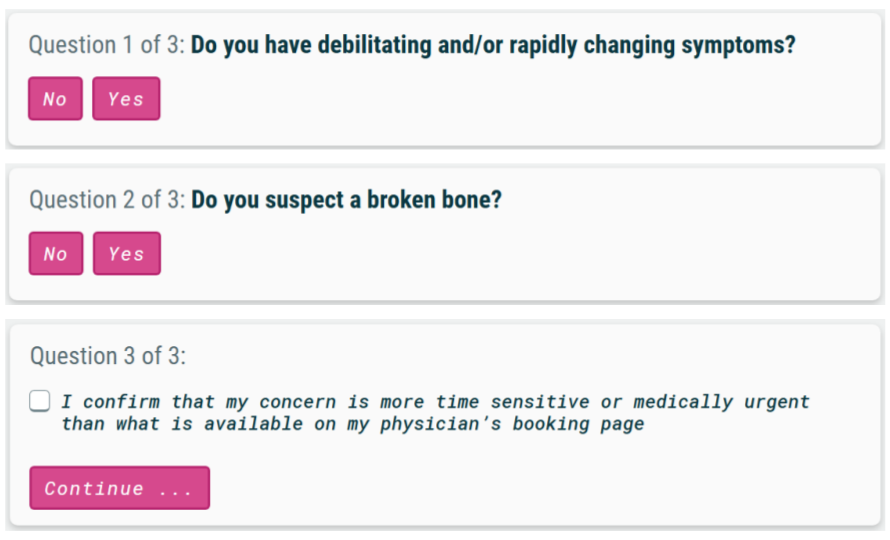
Before booking an on-call appointment, we ask brief screening questions to help make sure you’re booking the right type of visit for your concern.

This helps reduce booking errors, extra appointments,  and ensures you’re directed to the most appropriate care.


See All Available On-Call Appointments in One Place

No more clicking back and forth to check availability! 

We’ve added a new page where you can quickly review current on-call MD availability across our locations

It’s now quicker and easier to spot a time that works for you.


A Simpler, Faster Booking Form

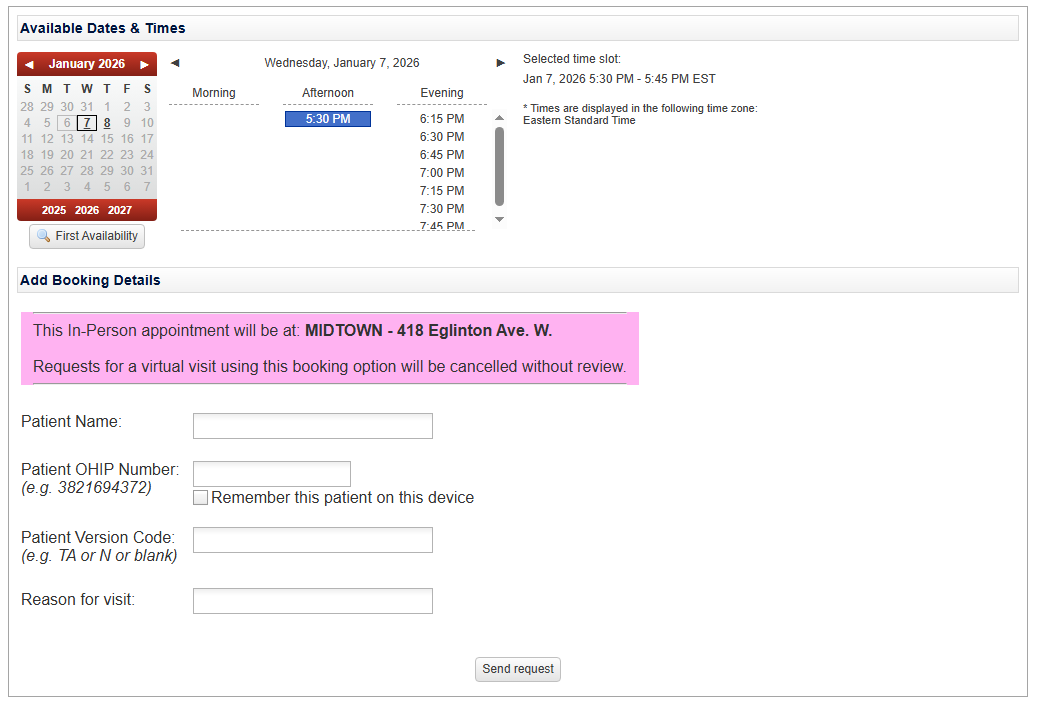
We’ve streamlined the on-call MD booking form to make it faster and easier to complete your booking.

By removing screening questions at this touchpoint, we’ve reduced friction and made accessing urgent care simpler.


How to access on-call MD booking?

  1. Our standard request is to always start at your physician’s homepage to ensure your concern is one that requires an appointment. You can review our blog post about how to use your physician’s homepage here.

  2. If your concern is one that does not require a specific non-urgent appointment type, you will be directed to a booking page that includes your physician’s regular appointments, and urgent appointments.

  3. If you don’t see a suitable time with your own physician, click the link at the bottom of the page to access urgent appointment availability with an on-call MD.

  4. You’ll be taken to our updated workflow, outlined above, where you can then continue to book as appropriate.


These updates are small but meaningful steps toward <Better Care/>. To learn more about the campaign and how we’re improving care for our patients, visit magentahealth.ca/better-care.

Improving Access to Care in Our Communities

We’re excited to share that Magenta Health is participating in Ontario’s Primary Care Action Plan, an initiative designed to improve access to primary care across the province.


What is Ontario Primary Care Action Plan?

In 2025, Ontario launched a provincial health strategy called the Primary Care Action Plan, with the goal of ensuring that every person in the province is connected to primary care. 

As part of the initial rollout of the action plan, communities within certain postal codes have been identified for priority access based on the greater challenges they face in accessing primary care. These postal codes will be offered expanded intake appointment availability so that patients in these communities are able to find a family doctor. 

How Is Magenta Health Participating?

We are working closely with our regional primary care network and Ontario Health Team to stream priority patients into an expanded intake availability pathway.

As a first step, Magenta Health has put together a revamped registration process that will identify these patients to better direct their registrations should they register with us.

We are also contacting priority patients in our system who have previously pre-registered to offer them the opportunity to access the expanded intake appointment availability.

As the action plan evolves, Magenta Health will evolve our processes to better support the plan’s goals.

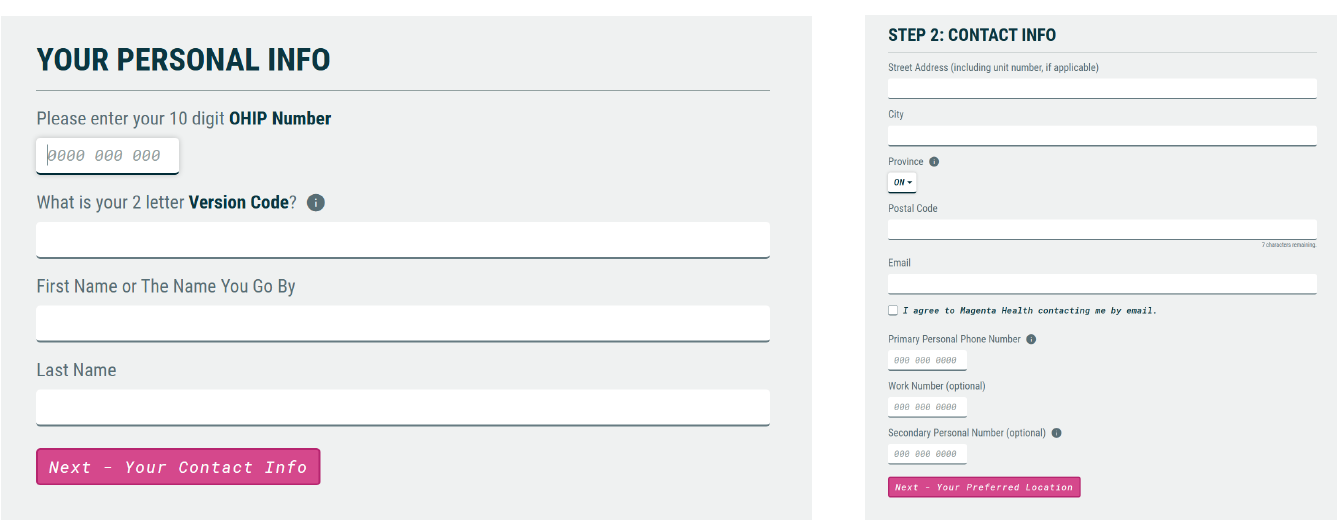
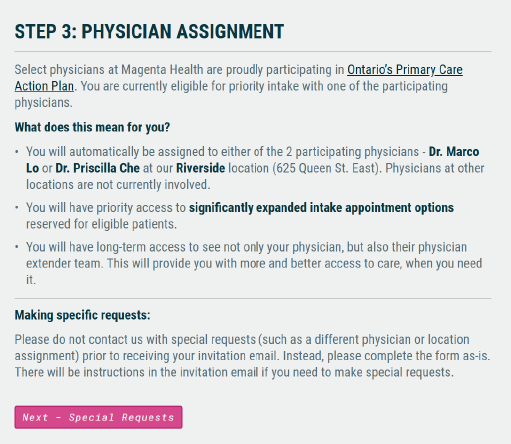
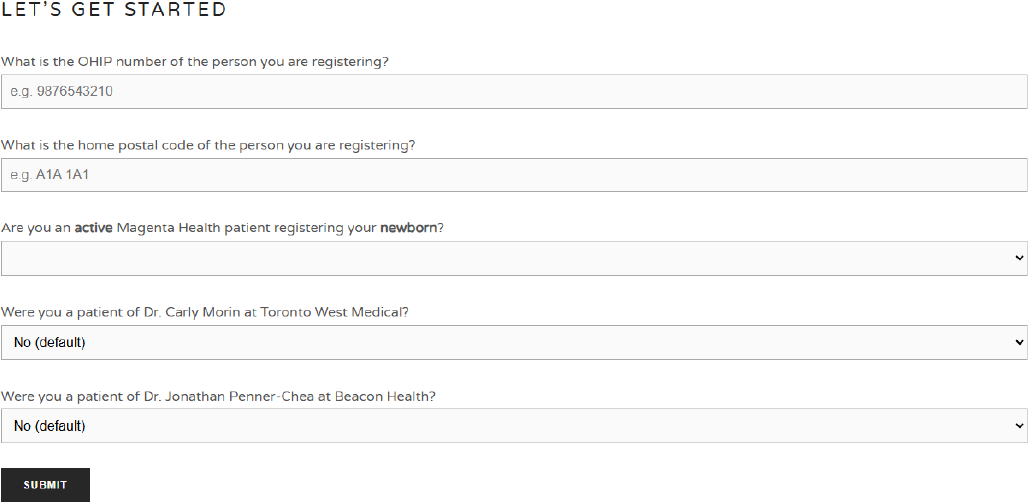
As seen in the screenshots below, patients in these priority postal codes are pulled into a different pathway once they start the registration process with us.


Step 1 - pre-registration

Step 1 - Initial pre-registration page

Postal codes are checked at this step.

Step 2 - contact information

Step 2 - Personal contact information page

Only prioritized postal code individuals or individuals within Magenta Health clinic catchment areas are redirected to a second form to collect more information.

Step 3 - prioritized stream

Step 3 - Prioritized postal code stream

Prioritized postal code individuals are then funneled into the expanded availability stream.

Important message for patients seeing Dr. Melinda Caputo Janhanger

A version of the following message was circulated electronically early December 2025.

We have exciting news! 

Back in May 2025, we shared this message: https://www.magentahealth.ca/blog/2025/5/20/important-message-for-patients-of-dr-lauren-mitsuki 

We are very pleased to announce that Dr. Melinda Caputo Janhager has decided to remain at Magenta Health for the long-term and take over as your primary care physician going forward. We’re delighted to confirm this stability in your care!

Please consider Dr. Caputo Janhager your family doctor “effective immediately”.  

The clinic will be making some other changes in the background. You might still see Dr. Mitsuki’s name from time to time while we make these changes.

Nothing changes for you—your usual process for booking appointments and contacting the clinic stays exactly the same.

*** Additional information from Magenta Health ***

  1. We would like to kindly note we won’t be able to accommodate requests for a different family doctor, inclusive of requests to switch clinics. There is already a significant shortage of family physicians both in the community and across the country, as well as a very long waiting list of patients attempting to book intake appointments with us. 

  2. Should you decide to transfer to a completely different physician outside of Magenta Health, please request your medical records by contacting us directly: https://www.magentahealth.ca/request-for-medical-records

Do You Need an Annual Physical? – Magenta Health Fall Update #5

This is the fifth message in our six part Magenta Health Fall Update series. These are short but important updates to help us provide you with <Better Care/>. In this update, we look at the common belief that everyone needs a yearly physical, and why the truth is different for each patient.

Do you need an annual physical?

It’s a common belief that everyone needs a physical every year. The truth is: that’s not always necessary.

Preventive care still matters

Even if you don’t need a “full physical” every year, it’s important to:

  • Stay up to date with recommended immunizations and screening tests

  • Keep a trusted family physician who knows your health history

  • Book an appointment if you have new symptoms, concerns, or risk factors*

* For specific symptoms: searching on your physician’s homepage will guide you to the right type of appointment. When in doubt, we recommend booking an in-person regular or urgent appointment so any needed assessment can be done promptly, without multiple visits.

Your Magenta Health care team is always here to guide you. If you’re unsure whether you need a physical this year, check your physician’s homepage or book an appointment to discuss your needs.

How this helps deliver <Better Care/>

Preventive care is most effective when it’s personalized and tracked. Our physicians use an open-source electronic medical record (EMR) system to manage test results, reminders, and follow-ups. Improving this shared system means safer, more reliable care not only at Magenta Health, but across clinics in Canada that use the same platform.

If you’d like to support these improvements, learn more or contribute monthly at: www.magentahealth.ca/better-care-2.

Thank you for staying proactive about your health: it’s the foundation of preventive care.

In-Clinic Advertising to Support <Better Care/> and Open Source EMR Development

At Magenta Health, we are always exploring new ways to make care better. Not only through the visits you have with your doctor, but through the technology that supports every part of that experience.

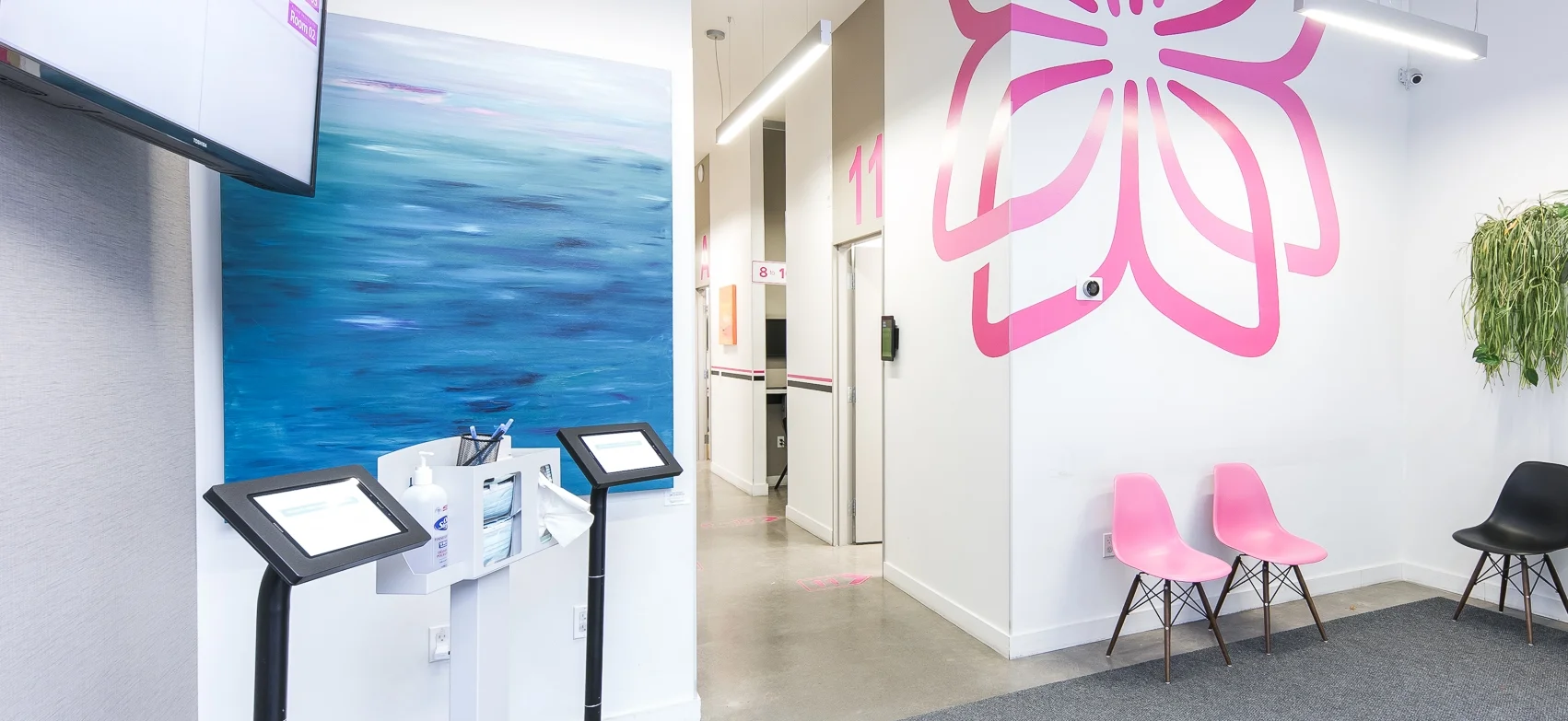
Recently, you may have noticed an ad while checking in at a kiosk in clinic, or on your personal device when completing a virtual check-in. Here is why:

A Pilot to Support <Better Care/> 

This is part of an eight-week pilot project between CHIME (our check-in platform) and a healthcare media company. The ad features a prescription medication, appearing as a still image in the clinic and as a short video online.

100% of all proceeds are going to our <Better Care/> campaign. These funds will pay for two full-time co-op students for a semester, supporting improvements to our electronic medical record (EMR) system. Their work will directly enhance patient privacy and patient care for both patients and clinicians.

What Patients Should Know

We know that some patients feel surprised or uncomfortable seeing a pharmaceutical ad in a clinical setting. We understand and respect that feedback, and we want to be clear about how this works.

Here are the key facts:

  • No data sharing: The ad is a simple, non-targeted image or video shown to all patients. No personal or health data is collected or sent to the advertiser.

  • Anonymous survey (now removed): A short optional survey originally followed the ad. It collected anonymous, aggregate responses only. After receiving patient feedback, we worked quickly with the media company to remove the survey altogether.

  • Limited trial: This is a short-term experiment, meant to explore sustainable ways to fund our open-source EMR development.

  • Independent decisions: Our physicians remain completely independent. Prescribing choices are made only on clinical evidence and patient need. No physician is receiving a financial benefit.

  • Compliance with regulatory requirements: Pharmaceutical ads are carefully regulated in Canada. The ads have passed legal review, and are similar to advertising typically seen in other clinics and healthcare settings.

Building Better Tools for Better Care

The <Better Care/> campaign is our ongoing effort to strengthen the connection between technology and care. By improving our EMR, we protect patient privacy, streamline communication, and reduce time spent on screens during visits.

We are learning from this advertising pilot, as we do from every experiment. Your input helps us make sure each decision aligns with our values of independence, privacy, and care quality.

To learn more about how <Better Care/> supports independent EMR development, visit magentahealth.ca/better-care.

Closing the Loop on Results for <Better Care/> – Magenta Health Fall Update #4

This is the fourth message in our six part Magenta Health Fall Update series. These are short but important updates to help us provide you with <Better Care/>. In this edition, we want to remind you why it is important to keep track of your tests and test results, and how doing so helps ensure nothing is missed.

Why this matters

It is a common belief that “no news is good news.” But when it comes to test results, that is not always true. Most results reach us without issue, but occasionally they can be delayed or misplaced due to human or technical error. Even with ongoing improvements to our systems and those of our community partners, mistakes can still happen. That is why closing the loop is so important.

How to collaborate on this

  • Sometimes your physician will order a test and explicitly say: “no news will be good news.” In those specific circumstances, you don’t need to follow up unless you have a concern.

  • Otherwise, for every test you complete, we encourage you to track whether you have heard back, and if you have not, to either follow up or ensure you bring it up at your next appointment.

  • If it has been longer than you would expect to hear back about your test results, you can use our online tool to prompt a follow-up (you will need to enter your OHIP number when using this link).

How this helps deliver <Better Care/>

Your collaboration helps close potential gaps and ensures nothing is missed. At the same time, we are continuously improving our electronic medical record (EMR) system to reduce the chance of errors at every step. These improvements mean better, more reliable care not only here at Magenta Health, but also at other clinics across Canada that use the same platform.

For example, we have developed internal audits that regularly scan our database for potential problems that need closer inspection. Eventually, we aim to automatically track every single test, but we are not there yet.

If you would like to support these improvements, you can learn more or contribute monthly at: www.magentahealth.ca/better-care-2

Closing the loop on results helps us catch potential issues early and strengthen our systems for the future. Thank you for being an active partner in your care.

Maintaining continuity helps your care flow smoothly – Magenta Health Fall Update #3

This is the third message in our six part Magenta Health Fall Update series. These are quick updates to help you stay on track with your health, while we continuously improve our tools and systems through our <Better Care/> campaign.

Why continuity matters

Health care works best when it flows without gaps. Each step connects to the next: appointments, tests, results, and follow-ups. When those steps happen on time, your care feels seamless. But if something lingers, like an unbooked test or an unanswered message, it can lead to delays that interrupt that flow.

How you can help keep care moving smoothly

  • Book and complete tests promptly: Bloodwork and imaging requisitions expire after six months. Early action prevents confusion and hassle. We estimate 25% of all requisitions expire without being completed.
  • Reply or confirm quickly: A short response keeps the next step moving, whether it’s scheduling an appointment or confirming details for a referral. Our team needs to follow-up manually on nearly 40% of all requests.

  • Stay engaged: Responding (using the link in our messages) when asked helps ensure your care team has the most up-to-date information to support you. 

What we’re doing to keep things moving

We know delays don’t just happen on the patient side. Sometimes your care team is waiting for a lab result, following up with a specialist, or reviewing your medical history before we can move forward. That can take time, and it’s part of why care sometimes feels slower than either of us would like.

That’s why we’re investing in improvements to make our work faster and more seamless:

  • Automated recalls that keep following up until an appointment is booked.

  • Smart forms that gather key information up front, reducing back-and-forth.

  • Improved referral tracking so you receive clearer updates as soon as we hear from specialists.

These upgrades help us respond more quickly and reliably here at Magenta Health, while also strengthening the shared EMR system used by clinics across Canada.

To read more about these improvements or see how you can get involved, visit: www.magentahealth.ca/better-care-2 

Your health care works best when we move together. By acting promptly on your side and improving systems on ours, we can make your care smoother and more reliable. Thank you for being such an important part of that process.

The Best Way to Reach Us for <Better Care/> – Magenta Health Fall Update #2

This is the second message in our Magenta Health Fall Update series. These short but important patient updates are designed to help us provide you with <Better Care/>. In this edition: how to reach your care team when needed.

Start with your physician’s homepage

Physician homepages are designed to guide you to the right path for your specific concern or request, while also reflecting your physician’s style of practice and the behind-the-scenes aspects of providing care. In short: we always recommend starting at your physician’s homepage.

Enter a short search term (e.g., “test results,” “renew prescription,” “rash,” “chronic pain”). The system will guide you to the right option, whether that’s messaging your physician, requesting admin support, booking an appointment, or accessing a resource.

Tips for better searching:

  • Too broad: “talk to my doctor” is a bit generic. A search like “colon cancer screening test” works better and may even deliver options that don’t require an appointment.

  • Too detailed: for privacy reasons, the tool doesn’t see your full medical history. Instead of searching, “form for my recent work injury,” just type “forms.”

Third parties can contact us via fax or online forms. Details here: third-party contact information.

If you don’t find what you need

Your physician’s homepage already addresses hundreds of different scenarios, but not everything unfortunately. There's ongoing efforts to address more scenarios and to offer better search capabilities. In the meantime, additional options for contacting us electronically or by phone are available here.

How this helps deliver <Better Care/>

Using your physician's homepage as a starting point typically means:

  • appointments are booked properly,

  • requests have the info your care team needs to move forward,

  • everything is recorded in your electronic medical record (EMR), and

  • inquiries reach the right person quickly.

This avoids delays, reduces errors, and helps your physician spend more time on care. 

We’re also continually enhancing our EMR system to make care more seamless at Magenta Health and across Canada. For example, when submitted through your physician's homepage, many medical forms are now uploaded directly into the EMR, reducing errors from manual entry while still allowing our team to review each submission for accuracy. These upgrades are part of our ongoing <Better Care/> improvements.

To read more, or see how you can support, visit: www.magentahealth.ca/better-care-2

Thank you for your help. It helps us respond faster and keep your care on track.