

Credit: Vitaly Gariev
Across primary care, many patients living with chronic conditions such as diabetes, chronic kidney disease (CKD), chronic obstructive pulmonary disease (COPD), and cardiovascular disease (CVD) may go undiagnosed, underdiagnosed, or may not be receiving the care and follow-up that current clinical guidelines recommend.
In many cases, the information needed to identify these conditions already exists within the patient record — in lab results, specialist reports, medication histories, or past clinical notes — but it is often spread across different parts of the chart and difficult to bring together efficiently in everyday practice.
At Magenta Health, we care for more than 40,000 active patients. Through our ongoing <Better Care/> campaign, we're exploring how improvements to our electronic medical record (EMR) system and AI-supported tools can help us make better use of existing health information to support earlier identification, preventative care, and more consistent chronic disease management across our patient population.
WHY THIS MATTERS
Much of chronic disease care today is reactive, meaning patients are often identified only after symptoms develop, concerns are raised during an appointment, or a clinician happens to recognize a pattern while reviewing the chart.
Family physicians often care for panels of more than 1,000 patients, many of whom are living with multiple chronic conditions that each require ongoing monitoring, follow-up, and guideline-informed care.
In a typical 15-minute appointment, there is limited time to review years of lab results, medications, and historical notes before focusing on the patient's immediate concerns.
While that information remains available within the chart, reviewing it across large patient panels and complex medical histories is much more challenging.
Reviewing patient records across an entire population is possible, but it can be highly labour-intensive — often requiring a team to manually examine individual patient charts for specific conditions, risk factors, or gaps in care. Doing this at scale requires significant time and resources, so this approach has often been limited to academic or research settings rather than becoming part of routine primary care.
Another key reality in primary care is that health information is often fragmented across multiple parts of the medical record.
Important clinical details may be found across specialist letters, hospital reports, imaging results, lab trends, and clinical notes over many years, but inconsistent organization can make it difficult to identify patients who may benefit from additional care.
As a result, some patients may not be identified until later in their disease progression — particularly those who are seen less frequently, face language barriers, have lower health literacy, or experience other challenges that make ongoing engagement with healthcare more difficult.
In response, we're working toward a more proactive, population-based approach to chronic disease care.
We’re actively exploring how AI-supported tools and improvements to our electronic medical record system could help reduce some of the manual work involved in reviewing large numbers of patient records. At the same time, we’re continuing our broader efforts to improve the access, organization, and use of healthcare information.
With the right tools, clinicians could safely and securely review records across an entire patient panel as part of routine care, helping identify individuals who may benefit from earlier intervention, updated treatment plans, preventive care, or referral to existing care pathways.
USING TECHNOLOGY TO SUPPORT POPULATION HEALTH

Credit: Nappy
To support our goals in chronic disease care, AI tools may help:
Identify patients who may have undiagnosed or under-recognized chronic conditions
Support earlier intervention through guideline-based risk identification
Improve consistency in chronic disease monitoring and follow-up
Reduce reliance on reactive, visit-based detection alone
By reviewing information across the full patient record, these tools may help care teams identify patterns or risk factors that could otherwise be difficult to detect across thousands of patient charts.
From there, relevant lab results, medication histories, specialist reports, and clinical notes can be brought together and presented in a more usable format for clinical review.
Any future solutions would operate within secure clinical environments, with patient information remaining within approved healthcare systems and privacy protections remaining our core priority throughout development and implementation.
Importantly, AI tools are intended to support care teams and clinical decision-making, not replace them. Clinical decisions will always remain in the hands of healthcare providers.
WHAT THIS COULD LOOK LIKE IN PRACTICE
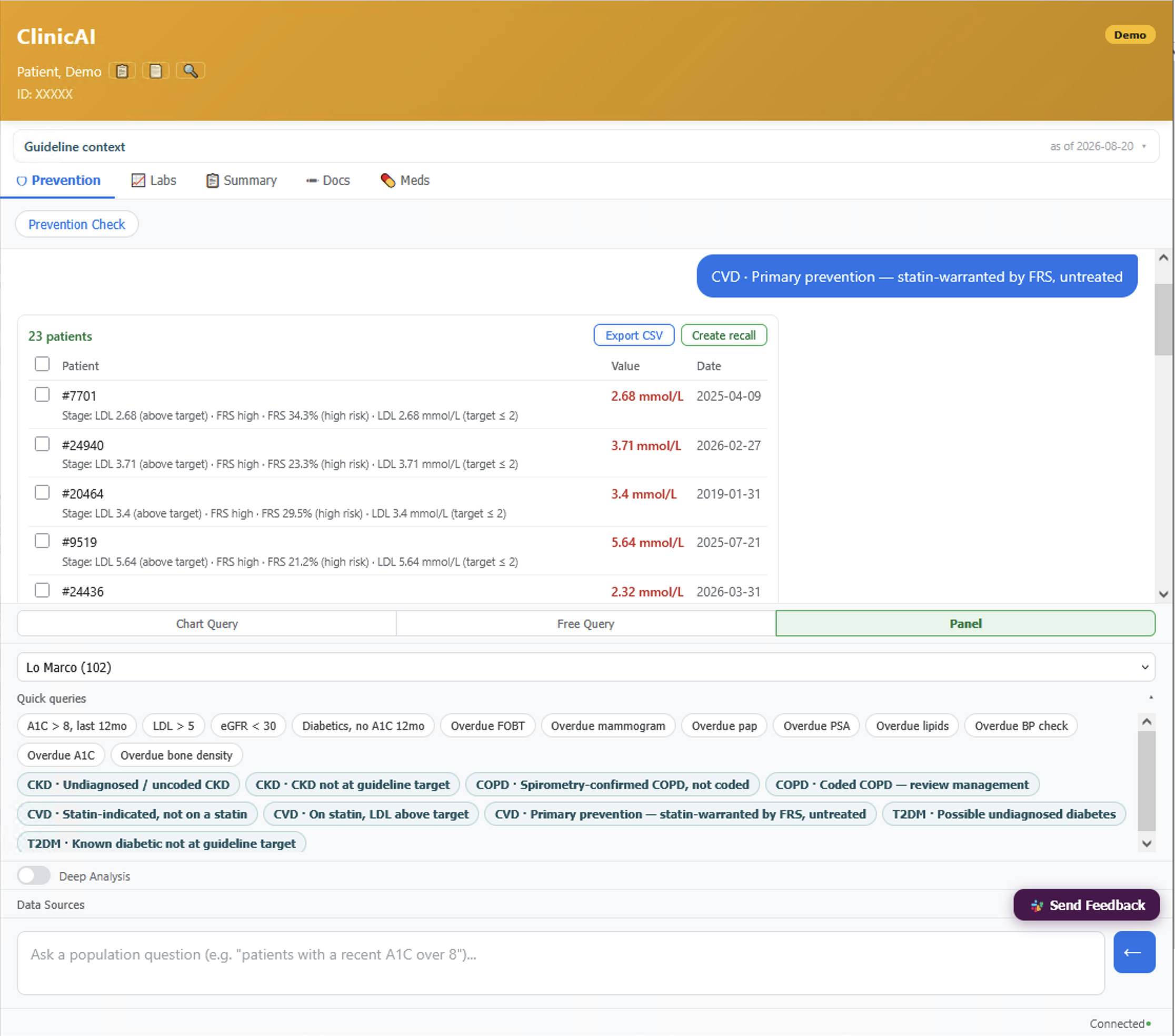
An example of how AI-supported tools can help care teams identify patients who may benefit from further review for cardiovascular disease prevention.
To help illustrate how AI-supported tools could support proactive chronic disease management, imagine a future tool designed to assist with the care of chronic obstructive pulmonary disease (COPD).
Using current Canadian clinical guidelines, the tool could securely review records across a physician’s patient panel to help identify potential gaps in care.
For example, it might surface patients who have already been diagnosed with COPD but who may not be receiving guideline-recommended treatment or follow-up. It could also flag patients whose records suggest they may have COPD but who have not yet been formally diagnosed.
Rather than making clinical decisions, the tool would present these findings as a report for the care team to review.
Based on that information, healthcare providers could decide whether any follow-up is appropriate, such as:
Reviewing a patient's chart more closely
Confirming whether recommended medications have been prescribed
Inviting a patient for additional assessment or testing
Discussing smoking cessation or other preventative care
Updating a treatment plan based on current clinical guidance
One key benefit of this approach is that patients would not need to present with new or worsening symptoms before potential care gaps or risk factors are identified. Instead, the goal is to support earlier intervention, before problems become more serious.
The report would simply help surface potential opportunities for review, giving care teams additional information to support their existing clinical workflows.
As this work evolves, we plan to continue collaborating with local healthcare partners and regional organizations to improve chronic disease detection and management across the broader healthcare system.
This means improvements created through projects like this have the potential to benefit patients and care teams far beyond Magenta Health's own clinics.
SUPPORTING BETTER CHRONIC DISEASE CARE THROUGH <BETTER CARE/>

Integrating AI-supported tools into clinical workflows represents a shift from reactive care toward more proactive, population-level chronic disease management.
Through our <Better Care/> campaign, we continuously invest in improving the shared open-source EMR system and broader tools that support nearly every part of care across our clinics.
By improving how existing clinical information is accessed, organized, and used, we aim to strengthen prevention, improve outcomes, and support more consistent care for all patients in our community.
If you'd like to get involved and help us continue building better tools for better care, you can learn more about <Better Care/> and contribute here.