
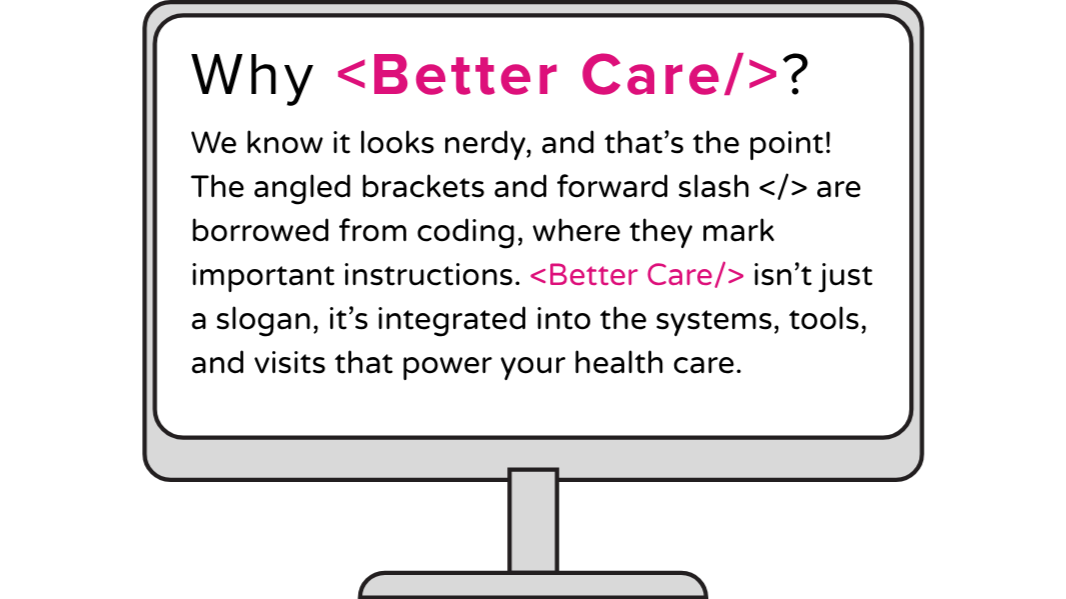
At Magenta Health, our electronic medical record (EMR) system is continuously evolving to provide safer, more reliable, and more accessible care — part of our broader <Better Care/> campaign to improve the systems that support patient care across our clinics and beyond.
Over the past year, we’ve focused on a wide range of upgrades to support day-to-day clinical workflows.
Behind the scenes, our software team works closely with physicians and an open-source EMR community to improve system functionality, strengthen safeguards, and ensure the EMR remains dependable as healthcare needs continue to evolve.
While some of these changes are visible on the surface, many happen in the background — and even small updates reflect months of design, testing, and continuous iteration to keep the system stable, secure, and reliable in practice. These improvements play a key role in how physicians and patients experience care every day.
Here’s a closer look at some of the work currently underway.
STRENGTHENING THE FOUNDATION

Credit: GuerrillaBuzz
A major focus has been on upgrading the underlying infrastructure that supports the EMR.
This includes:
Security enhancements to better protect patient data
Software updates and bug fixes across the system
Upgrades to legacy technology to improve performance and reliability
Much of this work involved bringing older systems up to modern standards — strengthening the “foundation” so everything built on top of it runs more efficiently.
For example, we improved performance on key clinical pages that had become slower as system usage and data volumes grew. These pages handle large datasets (including tens of thousands of records), which had begun to slow down load times for providers.
By reducing unnecessary background processing and improving data retrieval, we made these pages faster and more stable in day-to-day use, with less strain on the system overall.
IMPROVING EVERYDAY CLINICAL TOOLS
We’ve also introduced several updates designed to make everyday workflows faster and more intuitive for clinicians.
Recent improvements include:
A redesigned inbox with faster load times and a more user-friendly interface, helping physicians manage high volumes of incoming information and stay on top of important results
The ability to send emails directly from within the EMR. This reduces the need to switch between systems and avoids reliance on paid third-party tools
Expanding integrations with external clinical systems and provincial health data sources, making it easier for clinicians to access more complete patient information within their workflow
Enabling secure attachment sharing directly from patient charts, reducing the need to download files locally, and strengthening data protection
Together, these changes help reduce repetitive administrative steps and simplify common tasks. While they don’t solve broader system challenges on their own, they represent meaningful incremental improvements that can help reduce cognitive load and allow physicians to spend more time focused on patient care.
Many of these improvements are shaped directly by feedback from physicians and team members. Once developed, updates are also contributed back to the broader open-source ecosystem, allowing other clinics using the same system to benefit.
SUPPORTING BETTER COORDINATION AND COMMUNICATION
Credit: Helcim Payments
We’ve expanded functionality to help our care teams communicate and coordinate more effectively.
Key updates include:
Enhancements to electronic forms (eForms), allowing information submitted by patients or staff to flow directly into the EMR without manual entry — improving accuracy and saving time
Secure document-sharing tools that allow providers to exchange clinical information within the EMR, limiting reliance on email communication and strengthening privacy
Internal task reminders that help clinicians track follow-ups and patient actions within their workflows
For example, follow-up tasks can now be automatically created after an eForm is completed. This reduces manual steps for care teams and helps ensure important next steps for patients aren’t missed.
We’ve also improved system integrations to support more connected care:
Health card validation tools embedded across the EMR
Integration with drug reference databases to support safer prescribing and clinical decision-making
These updates help ensure information moves efficiently, accurately, and securely between care team members.
ONGOING INNOVATION AND SYSTEM IMPROVEMENTS
In addition to these changes, we continue to invest in ongoing improvements across the EMR.
Current work includes:
Enhancing overall system performance and developing new features to support clinical needs
Strengthening privacy and security measures to protect patient information
Continuously refining core functionality based on real-world use and clinician feedback
We are also more than halfway through a multi-year process to achieve Ontario EMR certification. This important milestone ensures the system meets provincial standards for reliability, compliance, and integration with broader healthcare infrastructure.
CONTINUOUS IMPROVEMENT IN PRACTICE
A core principle behind our EMR development is that improvement is ongoing.
Even when changes aren’t immediately visible, they reflect continuous work to strengthen and refine the system behind the scenes.
This work is part of our broader <Better Care/> campaign — focused on improving the shared open-source EMR that supports nearly every part of patient care, from booking appointments and tracking results to preventive care and follow-ups.
Across Canada, many clinics still rely on outdated systems that slow care down and increase administrative burden. By investing in modern, open, and continuously improving infrastructure, we aim to support better experiences for both clinicians and patients.
Learn more about <Better Care/> and support our EMR improvement efforts here.
BEHIND EVERY UPDATE
While many improvements happen out of view, work is always underway to strengthen safety, performance, and how the EMR operates in practice.
From the foundational upgrades to the everyday workflow improvements, each update contributes to a more reliable and efficient system for both patients and providers.
We remain committed to continuously improving the technology that supports better care — today and in the future.